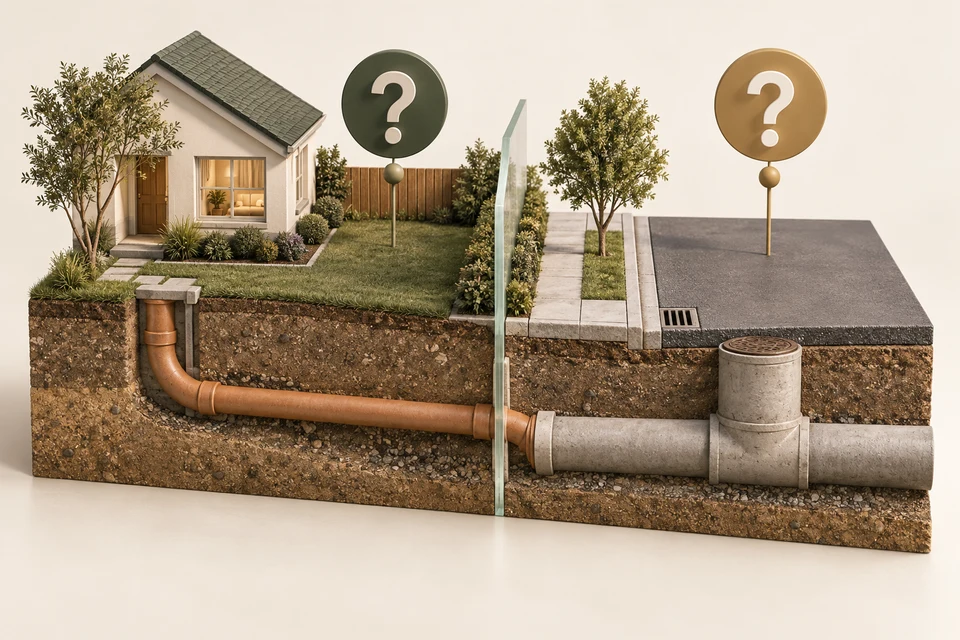
In most Alberta municipalities the owner is responsible for the sewer from the house to the property line and the city or utility for the part from the property line to the main, but details differ. Okotoks makes owners keep even the city-side connection clear, and some pages define no split at all. Confirm the rule for your municipality and measure where the defect sits before anyone digs.
- There is no single province-wide rule; each municipality or utility publishes its own split, and some pages do not define one.
- Before assigning responsibility, confirm three things: who owns each segment, who must maintain it, and exactly where the defect was measured.
- A camera distance is cable paid out, not a surveyed position; a surface locate compared against property records is what settles a defect near the line.
- Insurance for water damage from a backup is a separate question from who owns or pays for the pipe.
01 /Important legal notice
02 /What three things decide who is responsible?
Responsibility turns on three separate facts, and all three need confirming before any work is authorised. The property line is often part of the answer, but it is never the whole answer.
- Segment ownership: who owns each section of the service line, from the building to the main.
- Maintenance responsibility: what the current bylaw or utility policy says about keeping each section clear and repaired, which is not always the same as ownership.
- Measured defect location: where the problem actually is relative to the property boundary, measured and marked, not estimated.
Okotoks shows why the second point matters. Its Sanitary Sewer Bylaw 25-21 makes the owner responsible for keeping the connection clear from the property line to the Town's main, beyond the owner's lot, while the Town pays to repair that portion if the blockage comes from corrosion, deterioration or frost damage. Ownership and maintenance are split differently there.
03 /What do Alberta municipalities say, city by city?
The table summarizes what each municipality's public page says, as checked September 2026. Where the page does not define the split, the entry says so, and you should confirm with the named office.
| Municipality | Owner side | City or utility side | Where to confirm |
|---|---|---|---|
| Calgary | Service connections from the property line to the plumbing system; private-property servicing is owned by the builder or homeowner | Not stated on the connections page; for backups, a City crew snakes to the main to tell private from public | 311 |
| Edmonton (EPCOR) | Sewer lines on the property, including a backwater valve | EPCOR: from the property line to the main in the street or alley | EPCOR |
| Red Deer | Page does not define the repair split | Page does not define the repair split; any removal or installation of services needs Engineering Services approval | Engineering Services, 403-342-8158 |
| Airdrie | The privately owned section between the building and the property line | Not defined on the claims page | City of Airdrie |
| Okotoks | Keep the connection clear from the property line to the Town main (Bylaw 25-21, s.5.7) | Repair costs on that portion if caused by corrosion, deterioration or frost damage | Town of Okotoks |
| Lethbridge | Permits page does not define the split | Permits page does not define the split | 311 or 403-320-3111 |
| Medicine Hat | The lateral from the home to the property line | The lateral from the main to the property line, and the mains | City of Medicine Hat |
| St. Albert | Sewer issues page places the service line with the homeowner | Replacement program covers the City portion, mainline to property line | Public Works; Utilities 780-459-1500 |
Some details sit behind those rows. Calgary's connections page states it has no legal status as an official bylaw interpretation. EPCOR will not reimburse plumber's fees regardless of where the blockage is, and charges a fee if prohibited waste caused it. Medicine Hat takes responsibility for root infiltration on public-property piping from public-property trees only, and charges a fee for City crews to clear private blockages. St. Albert's two pages frame the boundary differently, so ask Public Works which segment is yours before relying on either. The Alberta City Sewer Rules Finder returns each municipality's entry with its source link, and the cities page covers local permit steps.
04 /How do you locate a defect before authorising work?
Locate the defect on the ground, not just on the video, and compare that mark with property records. A defect near the boundary is the one most likely to be argued over, and the one most often mis-measured.
- Record the camera distance
Note the distance reading at each defect, the entry point (for example the basement cleanout), and the recording date. Keep the full video, not just a summary.
- Know the limits of the counter
The counter measures cable paid out, not straight-line distance. Bends, fittings and slack can add length, so a reading near the property line is not proof of which side the defect is on.
- Surface-locate it
Ask the operator to find the camera head with a sonde locator and mark the ground above each significant defect, noting estimated depth.
- Compare with records
Measure the mark against a real property report or survey and any municipal service record showing where the line runs and connects.
- Ask the utility in writing
Share the video, the measurements and the mark, and ask who owns and who maintains that segment.
- Then authorise work
Only once the answer is in writing should it be reflected in a scope and a contract.
05 /Common responsibility scenarios
| Scenario | Likely location | Responsibility | First action |
|---|---|---|---|
| Blockage or defect in the service line on the lot | Between the house and the property line | In Calgary, Edmonton, Airdrie and Medicine Hat, the cited pages place this with the owner | Record the camera distance and locate before hiring work |
| Backup affecting several homes on the street | Possibly the municipal main | May involve public infrastructure; the utility decides | Report through the municipal channel (311 in Calgary) |
| Defect near the property line | Close to the boundary | Depends on the measured location and local rules | Share the recording, mark and survey with the utility |
A fourth case catches people out: a relined city section. Calgary runs a Sanitary Lateral Lining pilot that installs liners inside existing sanitary service pipes in older communities, working from manholes. The page does not say which portion is lined or who pays, so confirm with 311, and remember that a relined section says nothing about the condition of the private side.
06 /What should you know about insurance and municipal claims?
Insurance and pipe ownership are separate questions. The Insurance Bureau of Canada says basement water damage from a sewer backup is covered only if you bought optional sewer backup coverage, and that groundwater and seepage coverage are typically not standard. Whether a policy pays anything toward the pipe itself depends on the policy, so ask your insurer.
- Notify your insurer promptly and keep dated photos, the camera video and all correspondence with the utility.
- A claim against a municipality has its own rules. Airdrie, for example, says claims against the City must be reported within 30 days of the loss, through Insurance and Risk Management at 403.948.8831, as checked September 2026.
- Do not assume a city pays because a city tree or city pipe is nearby; ask, and budget as if the private repair is yours until told otherwise.
Paying for the work, contracts and claims are covered in more depth in sewer replacement insurance and paying.
07 /Before you call: a quick decision tree
- Only one fixture affected? Probably internal plumbing; start with a plumber.
- Several neighbours affected? Notify the municipality or utility.
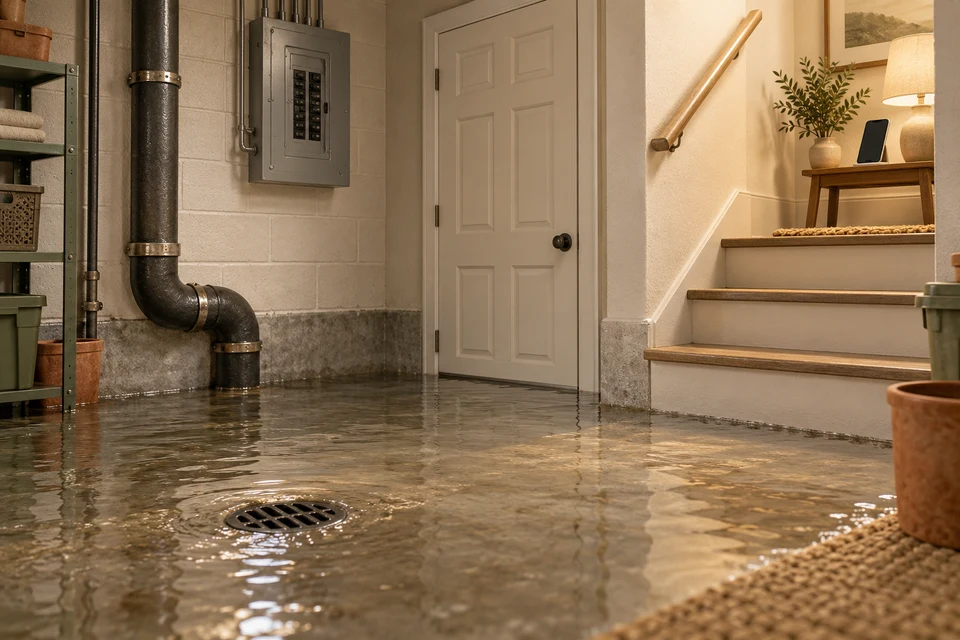
- The lowest drain is backing up? Stop using water, report through the municipal channel, and find and expose your cleanout.
- Sewage coming from public infrastructure? Keep clear and notify the municipality.
- Unsure where the defect is? Get a recorded camera run with distances and a surface locate.
- Active backup in the house? Use the urgent intake and safe first steps page.
08 /Getting the evidence organised
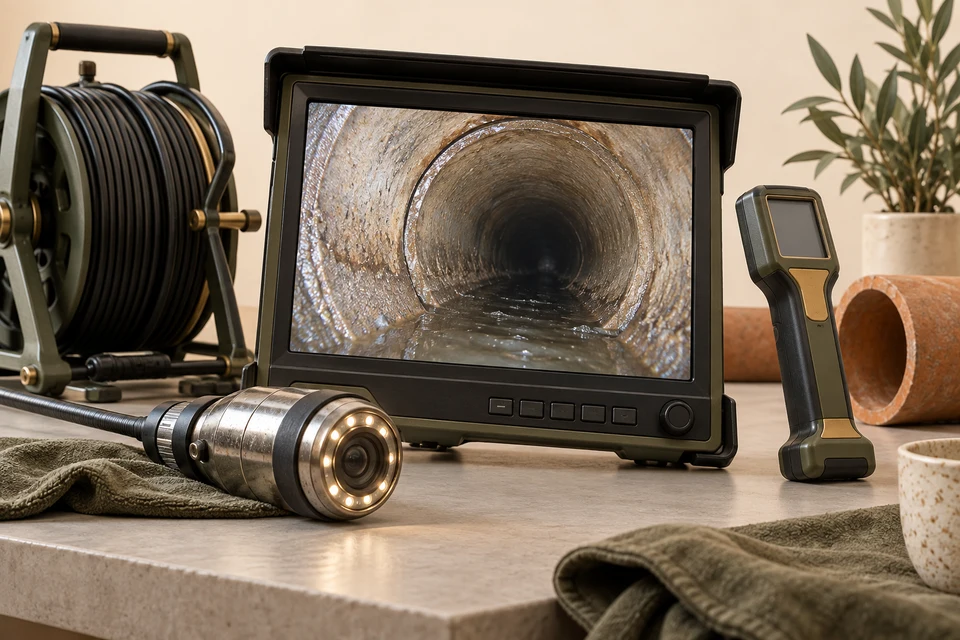
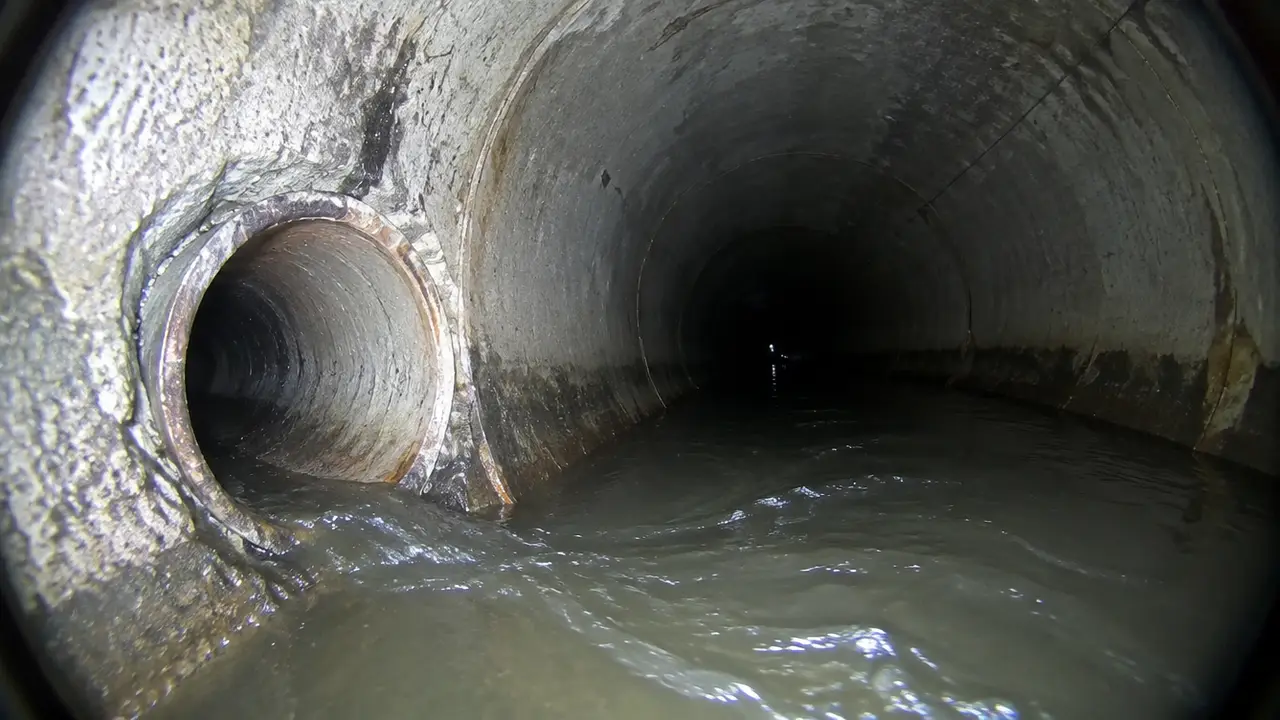
When responsibility is unclear, a recorded camera run with a locate documents the distance reference, the defect position against known boundaries, what the pipe looks like and the limits of the recording. It does not decide ownership; the municipality or utility does. The sewer camera evidence page explains what a useful recording includes.
Whoever owns each segment, prevention helps everyone: keep grease out of drains, flush only toilet paper and human waste, keep the cleanout reachable, and keep copies of past camera recordings and repair records. When you have the video and the utility's answer, send them through the request form to compare scopes.
FAQQuestions people ask
In Okotoks, who pays when the sewer connection between the property line and the Town main is blocked?
Under Bylaw 25-21, s.5.7, the owner is responsible for keeping that connection clear and pays for adequate flow, unless the blockage results from corrosion, deterioration or frost damage to that portion; then the Town is responsible for repair costs on it.
Does the City of Red Deer define who repairs which part of a residential sewer service?
Its installing services page does not define the repair split. It does say removing or installing services needs Engineering Services approval under Utility Bylaw 3606/2018, and that Engineering Services can provide the location of a lot's existing services.
Will EPCOR pay the plumber if the blockage turns out to be on the Edmonton city side?
No. EPCOR states it will not reimburse plumber's fees regardless of where the blockage is. EPCOR is responsible for the pipe from the property line to the main, and offers a basic service to help diagnose drainage problems.
Is the St. Albert service line the homeowner's or the City's to replace?
The two City pages frame it differently: the sewer issues page places the service line with the homeowner, while the replacement program covers the City portion from the main to the property line. Confirm with Public Works for your address.
How long do Airdrie homeowners have to report a sewer backup claim against the City?
The City's claims page says claims against the City must be reported within 30 days of the loss, through Insurance and Risk Management, as checked September 2026. Tell your own insurer about the loss too.
Does Medicine Hat cover roots from a City boulevard tree that damage the private side of a lateral?
The City's wastewater page says it is responsible for root infiltration on public-property piping from public-property trees only. Roots in the private section, from the home to the property line, remain the owner's responsibility.
NETWORKGo deeper across the HAUSE Sewer network
Whose tree, whose pipe: who pays when roots block a sewer line
Who is responsible when a city or neighbour's tree sends roots into your sewer line: the general Canadian pattern, the evidence, and how to raise it.
SewerInspector.caRenting a sewer camera and scoping your own line
Can you rent a sewer inspection camera and scope your own line? What rental and consumer cameras do, how to use one safely, and where DIY falls short.
SewerQuotes.comSewer line insurance: what service line coverage costs and pays for
Sewer line insurance in Canada: how service line coverage differs from sewer backup, what it covers and costs, its limits, and when it is worth buying.