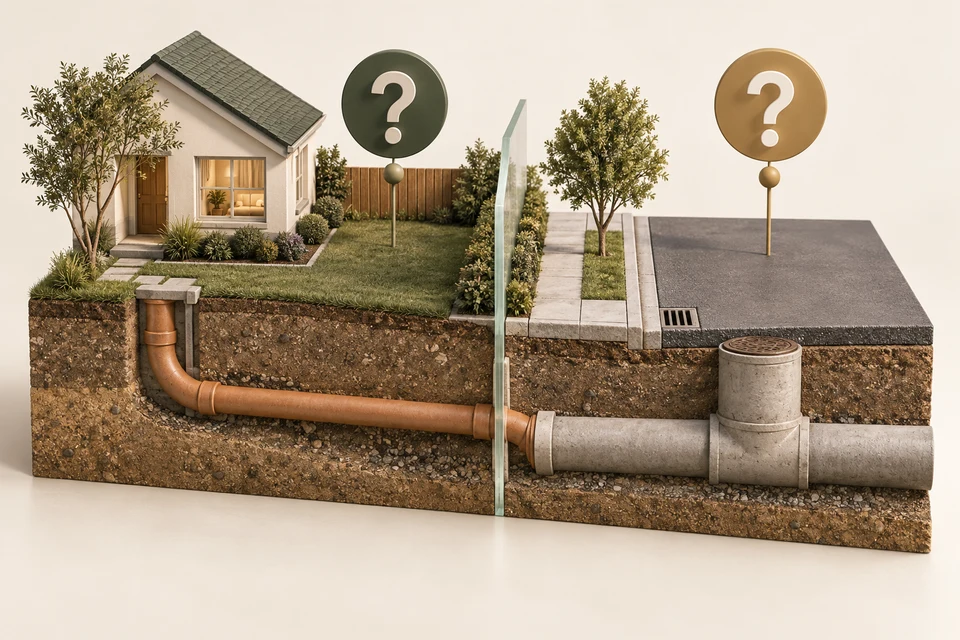
Sewer replacement rules in Alberta are set by each municipality, and in Edmonton by EPCOR. Most published pages put the owner side between the building and the property line, but Okotoks, Red Deer, Lethbridge and St. Albert frame it differently, and every municipality has its own permit or approval path. Confirm ownership, permits and contractor credentials for your address before authorising work.
- There is no province-wide property-line rule: each municipality publishes its own split, and some do not publish one at all.
- Replacing a sewer line is permit or approval work in every municipality reviewed; who may apply differs.
- Customer-owned sewer laterals are never marked by Utility Safety Partners, so a private locate is part of every Alberta job.
- City pages here are summaries of public pages as checked September 2026, not legal interpretations or an offer of service.
01 /Why does sewer replacement differ between Alberta cities?
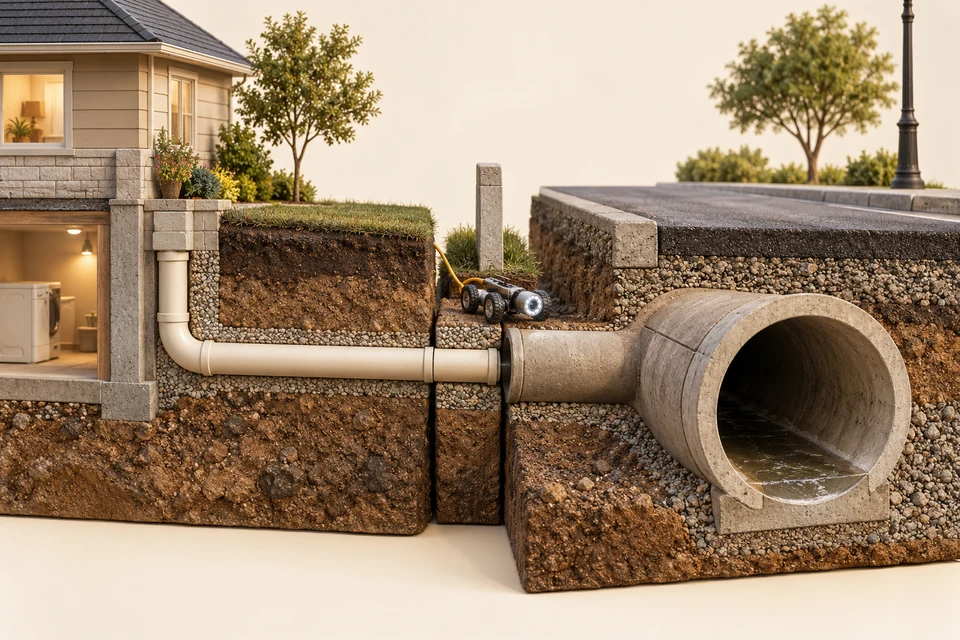
Because the pipe from a house to the main crosses a boundary that each municipality defines for itself. The Safety Codes Act and the National Plumbing Code of Canada 2020, in force in Alberta since April 1, 2023, set how plumbing is built, but who owns each metre of a sewer service, who approves work on it and who may apply are local decisions. Calgary, Edmonton, Red Deer, Airdrie, Okotoks and Lethbridge each answer them on their own pages, and Medicine Hat and St. Albert add two more patterns.
These pages organise city-specific questions for property owners reviewing an existing, failed sewer line. They do not mean that a provider is available or approved at your address. Availability, permits, ownership boundaries and provider credentials must be confirmed for each property, and that is what the Alberta City Sewer Rules Finder is built to help with.
02 /How do the six city guides compare?
| Municipality | Who owns what | Approval | Distinctive rule |
|---|---|---|---|
| Calgary | Owner: property line to building | Plumbing permit; contractor applies, or an owner-occupier doing own work | City-connected work inspected under a Master Indemnification Agreement |
| Edmonton | Owner: lines on the property; EPCOR: property line to main | City of Edmonton plumbing permit | EPCOR does not reimburse plumber's fees; backwater valve subsidy up to $800 |
| Red Deer | Not defined on the approval page | Engineering Services approval under Utility Bylaw 3606/2018 | City lists asphalt, curb, sidewalk and turf items with service work |
| Airdrie | Owner: building to property line | Accessory permit for plumbing | 30 days to report a claim against the City |
| Okotoks | Owner keeps the connection clear to the main | Written CAO approval for connection work | Town repairs corrosion, deterioration or frost damage past the property line |
| Lethbridge | Not defined on the permit page | Plumbing permit to replace sewer connections | Resident homeowner may apply if competency is shown |
Each city guide carries the camera evidence to request for that municipality, the permit, locate and restoration plan, when open cut or trenchless belongs in the conversation, and the local cost factors. Planning ranges for every method are on the Alberta pricing page.
03 /What do Medicine Hat and St. Albert publish?
Medicine Hat publishes one of the clearest splits in the province. Its wastewater page says the home or business owner maintains the sewer lateral from the building to the property line, and the City maintains it from the main to the property line, along with the mains. Roots follow the same line with one twist: the City is responsible for root infiltration in public-property piping only when the roots come from public-property trees. Since April 1, 2020 the City has charged a fee to clear blockages on private property (403-529-8176 during business hours), and installing a backwater valve is at the homeowner's discretion. Permits for replacement are not described on that page, so confirm them with the City.
St. Albert frames the boundary two ways. Its sewer issues page describes the service line, the piping from the house to the wastewater main, as the homeowner's. Its household sewer service line replacement program, meanwhile, repairs, maintains or replaces aged service lines on the City portion, from the main to the property line, with CCTV before and after; the 2026 work was scheduled for July to October at listed addresses, and about 1,200 services are inspected each year to find candidates. Because the two pages read differently, ask Public Works who owns the segment where your defect sits.
St. Albert also sets a practical condition on City help: its cleaning and camera assistance needs a 4-inch cleanout inside the home, and smaller cleanouts are not normally eligible. Backups are reported to 780-459-1500 on weekdays from 8 a.m. to 5 p.m., and a Utilities operator assesses. If you are replacing a line there anyway, adding a full-size cleanout is worth pricing.
| Question | Medicine Hat | St. Albert |
|---|---|---|
| Owner side | Home or business to the property line | Service line described as the homeowner's; confirm |
| Municipal side | Main to the property line, and the mains | City program works from the main to the property line |
| Roots | City: public piping, public trees only | Not described; confirm |
| City help on private blockages | Fee since April 1, 2020 | Needs a 4-inch interior cleanout |
| Backwater valve | Homeowner's discretion | Maintain periodically if you have one |
04 /What applies everywhere in Alberta?
Three rules hold in every municipality, and a good contractor raises them before you do.
- Locate before digging
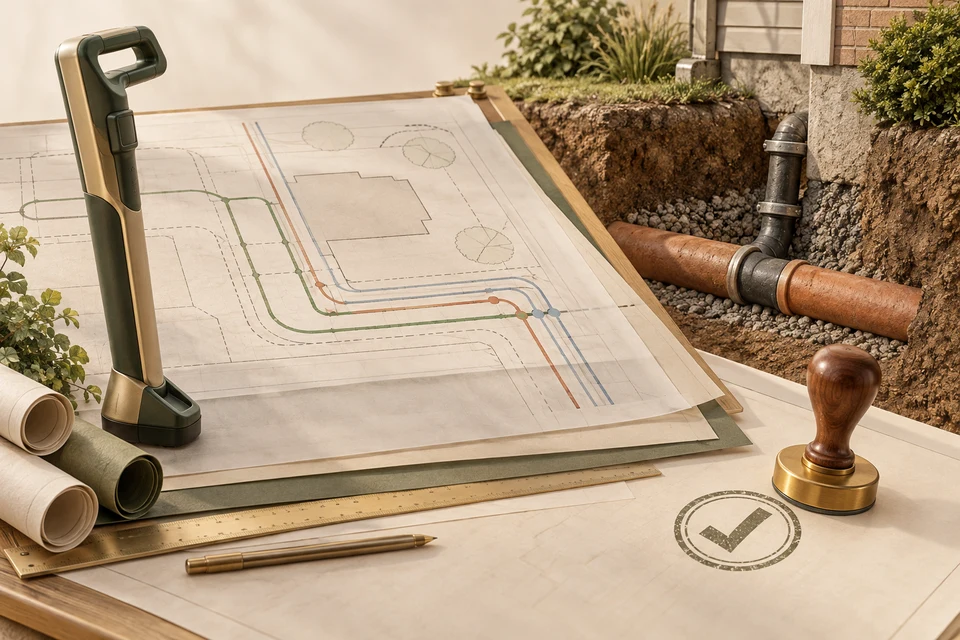
Utility Safety Partners asks for a Click Before You Dig request at least three full working days ahead (online or 1-800-242-3447). Customer-owned lines, including your sewer lateral and water service, are not registered and are not marked, so a private locator or a camera sonde has to find them.
- Hand-dig near the marks
Within 1 m either side of a locate mark, or 5 m of a high-pressure pipeline, the line is exposed with hand tools. Marks give approximate location, never depth.
- Protect the trench
Under Part 32 of the OHS Code, a worker in an excavation more than 1.5 m deep and closer to the wall than its depth must be protected by cut-back walls, a temporary protective structure or both, and spoil must sit at least 1 m back from the edge.
The full sequence, with what a contractor should show you before the excavator arrives, is in utility locates and safe digging.
05 /What should I confirm before work is authorised?
Ask who owns each section of pipe, which permits and inspections apply, how utilities will be located, and what qualifications the selected contractor carries. Requirements and availability differ by municipality and provider, so get the answers in writing.
- Ownership: which side of the property line is the defect on, measured from the camera record and a surface locate, and does the municipality agree in writing?
- Approval: which permit or approval applies to this scope, who applies, and which inspections will be booked?
- The connection: does the work touch the municipal connection, and does the municipality restrict who may do that part?
- Locates: who files the public locate request, and who finds the private lateral and water service?
- Credentials: is the contractor licensed where the municipality requires it (Edmonton requires City licensing; Lethbridge a City business licence), and do they hold what Alberta requires for sewer and water services work?
- Restoration: which surfaces, private and public, are included, and to what standard?
Two tools help with the paperwork. The Replacement Readiness Check tells you whether your camera evidence is enough to price anything, and the sewer responsibility guide walks through the scenarios where the boundary decides who pays.
06 /What about Alberta municipalities not listed here?
The same questions apply, but the answers have to come from your municipality. Many place the owner side between the building and the property line, but that is not universal: Okotoks, for example, keeps the owner responsible for a clear connection all the way to the main. Ask your municipality or utility, in writing, who owns and maintains the segment where the defect sits, and which permit issuer handles plumbing work. Contractors may need a Restricted Certificate of Competency "R" for sewer and water services in Alberta, so ask to see it.
Alberta-wide cost drivers, from frost-depth trenches to frozen-ground digging, are explained in why Alberta replacements cost more, and do-it-yourself permits in can I replace my own sewer line. Wherever you are, you can send your camera report and address and the desk will reply with next steps. HAUSE is an information and request network, not a contractor, and does not promise availability in any municipality.
FAQQuestions people ask
Is there one sewer ownership rule for all of Alberta?
No. Each municipality, or utility in Edmonton's case, publishes its own split, and some pages do not define one. Confirm for your address.
Which Alberta city pays for roots in the public part of a sewer lateral?
Medicine Hat says it is responsible for root infiltration in public-property piping when the roots come from public-property trees. Elsewhere, ask your municipality.
Does St. Albert replace the City part of household sewer lines?
Its household sewer service line replacement program works on the City portion, from the main to the property line, at listed addresses. Ask Public Works whether yours is included.
Do I need a permit to replace a sewer line anywhere in Alberta?
Every municipality reviewed treats it as permit or approval work, but the body and the applicant differ. Check your city page or ask your permit issuer.
Will a locate company mark my sewer lateral in Alberta?
No. Utility Safety Partners says customer-owned lines such as sewer and water service lines are not registered or marked; a private locator finds them.
Can SewerReplacements.ca arrange work in smaller Alberta towns?
You can send a request from anywhere in Alberta. HAUSE is an information and request network, so availability depends on location and is not promised.