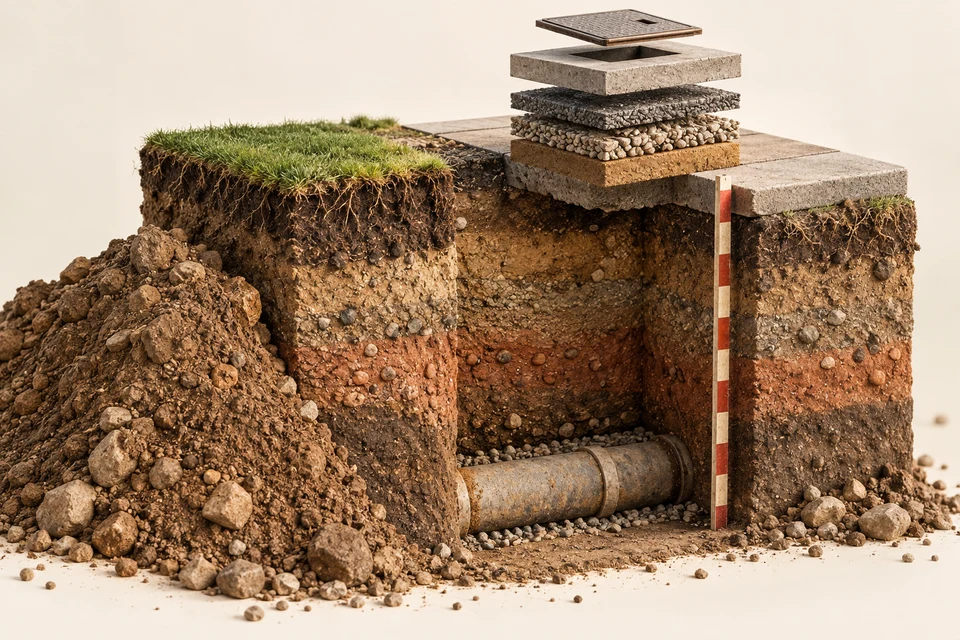
Alberta sewer replacements cost more mainly because the pipe is deep. Building sewers sit below frost, so trenches often pass the 1.5 m depth where the OHS Code requires cut-back walls or shoring. Clay, groundwater and winter frost slow the dig, restoration and city-side work add their own line items, and quotes in metres look larger than the per-foot numbers found online.
- Depth drives almost everything: a deeper pipe means more soil moved, wider or shored trenches, more backfill and more restoration.
- Past 1.5 m, Alberta's OHS Code requires walls cut back at 30° or 45° from vertical, or a protective structure, and spoil kept 1 m from the edge.
- Winter adds frost removal and slower production, and clay and groundwater add pumping, imported bedding and compaction time.
- City-side work such as asphalt, curb, sidewalk and turf repairs, plus permits and inspections, can be a large share of the total.
- Convert per-metre quotes to per-foot with 1 m ≈ 3.28 ft, and never compare a full Alberta quote with a pipe-only US per-foot figure.
01 /What makes an Alberta sewer replacement expensive?
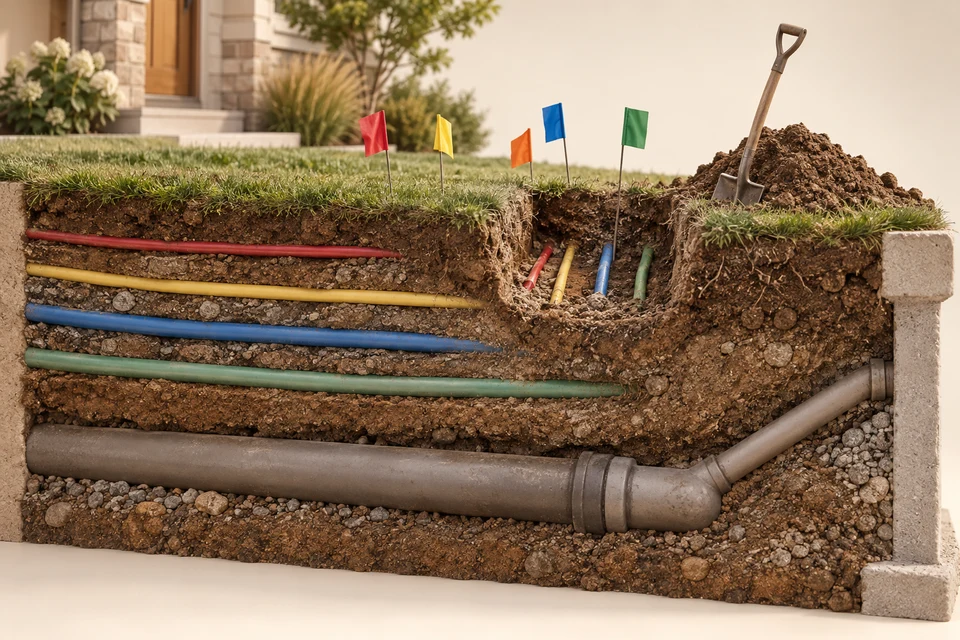
The short answer is depth, and everything depth drags along with it. The pipe itself is a small part of the bill. Most of the money goes into getting down to the pipe safely, working around what is on top of it, and putting the ground back afterwards. In Alberta, each of those steps is harder than in milder climates.
Quotes on this site's pricing page show the effect clearly. An open-cut replacement of a 15–25 m lateral under soft landscaping at less than 2 m deep has a typical quoted range of $12,000–$25,000, or $600–$1,000 per metre. The same length at 2.5–4 m, or under hard surfaces, moves to $22,000–$50,000+, at $1,000–$2,000 per metre. Nothing about the pipe changed. The hole did.
02 /Why are Alberta sewer lines buried so deep?
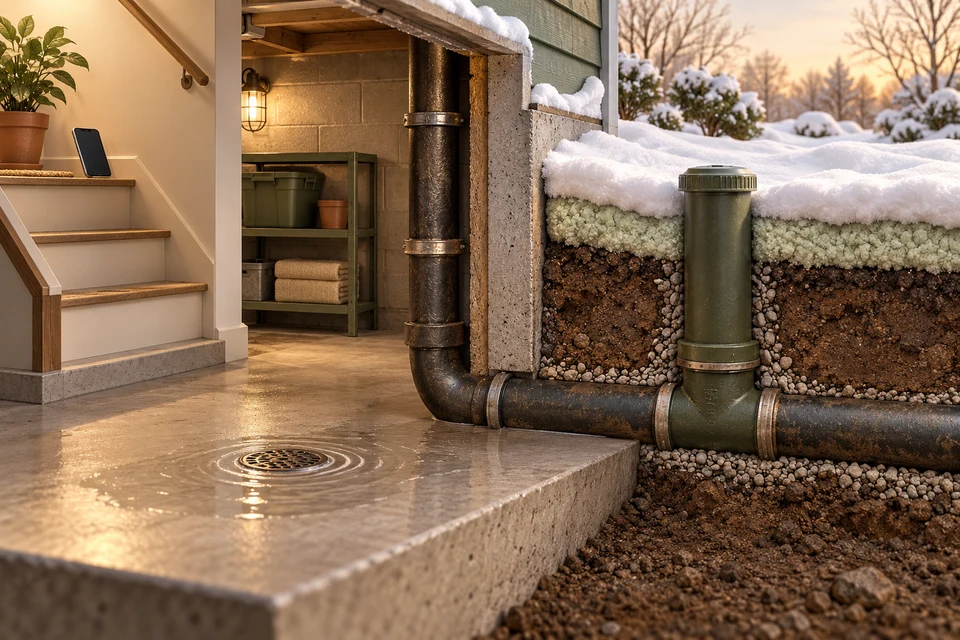
Because a sewer that freezes stops working. Building sewers are laid below the depth frost reaches so wastewater keeps moving through the coldest weeks, and Alberta winters drive frost deep, particularly under driveways and walks that are cleared of insulating snow. The pipe also has to fall steadily from the basement to a municipal main that is itself buried deep in the street.
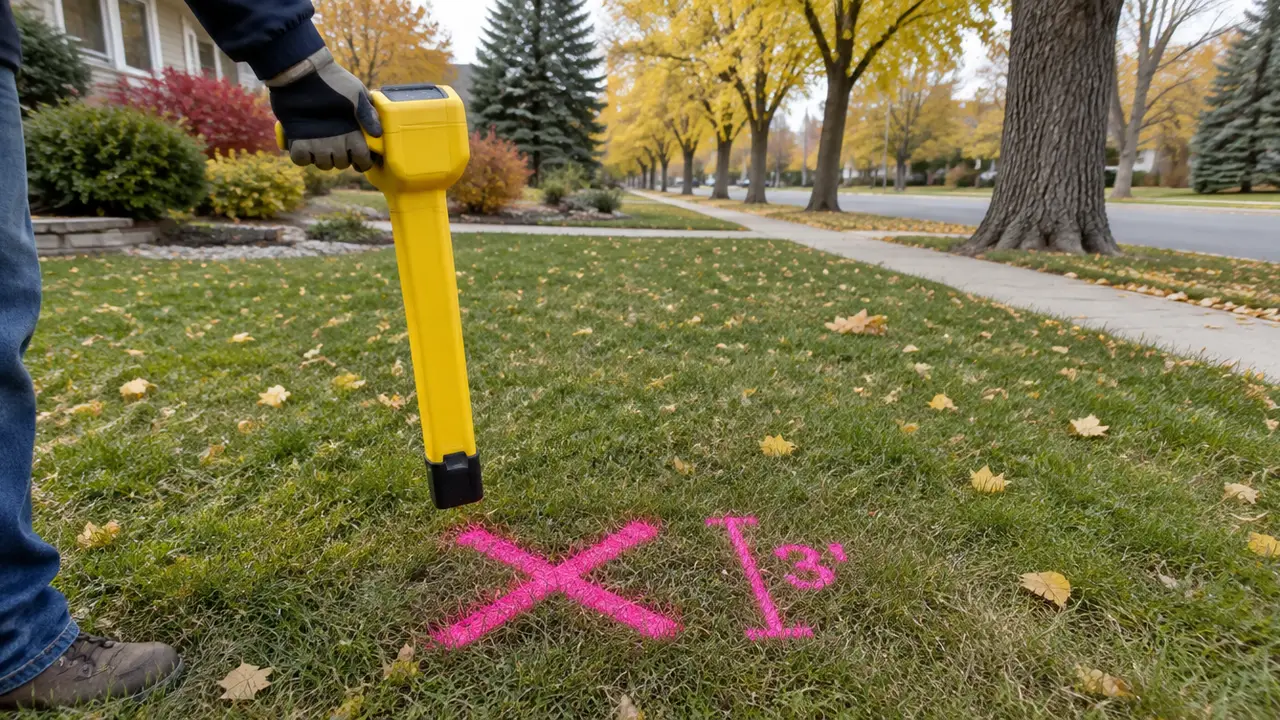
Your line's actual depth varies with the lot, the age of the house and the depth of the main, so measure rather than assume. A camera with a sonde transmitter gives an estimated depth at points along the run, and a contractor who has done that locate can price the dig far more accurately. The winter emergencies guide covers what happens when a shallow section freezes.
03 /How do Alberta's trench rules change the price past 1.5 m?
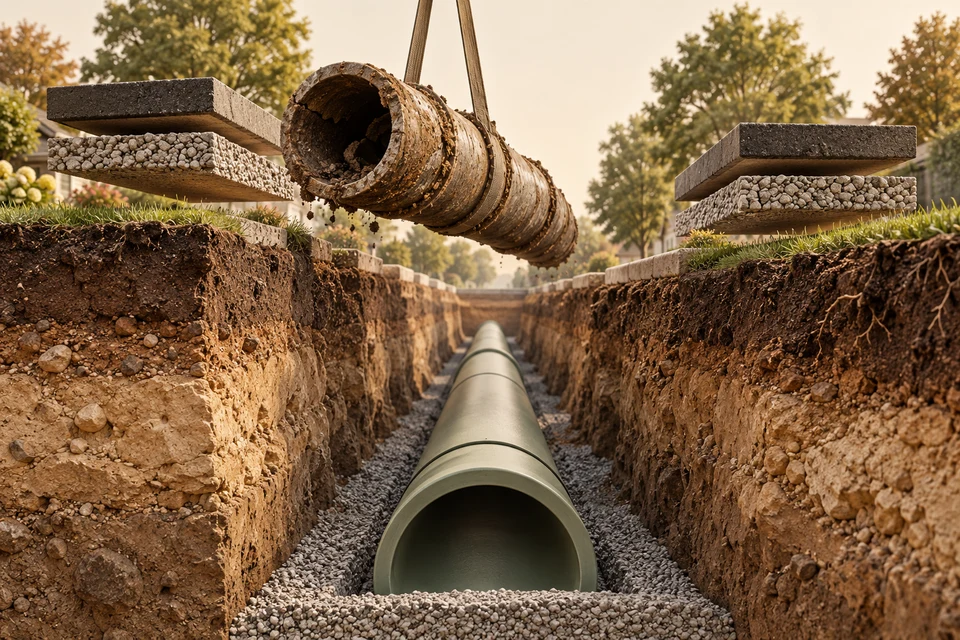
Once a trench is deeper than 1.5 m, the crew must either cut the walls back or install a protective structure, and both cost money. Alberta's OHS Code, Part 32, s.450 requires protection for a worker in an excavation more than 1.5 m deep who is closer to the wall than the excavation is deep. Section 451 sets the slopes, and s.453 keeps spoil piles at least 1 m back from the edge with a slope of not more than 45°.
| Soil type | Required slope | Extra width per wall, 3 m trench (approx.) |
|---|---|---|
| Hard and compact | Not less than 30° from vertical, to within 1.5 m of the bottom | About 0.9 m (1.5 m of sloped wall × tan 30°) |
| Likely to crack or crumble | 45° from vertical, to within 1.5 m of the bottom | About 1.5 m (1.5 m × tan 45°) |
| Soft, sandy or loose | 45° from the bottom | About 3 m (3 m × tan 45°) |
Read the last row carefully. In loose soil, a 3 m deep trench needs roughly 3 m of extra width on each side, so the top of the excavation could be more than 6 m across before the 1 m spoil setback. Beside a foundation, a fence or a neighbour's garage, that rarely fits. The alternative is a trench box or shoring, which keeps the trench narrow but adds equipment, set-up time and handling on every move. The geometry here is simplified; the Code, the actual soil and a competent person on site decide what is required.
04 /How do clay soils and groundwater add cost?
Clay is slow to dig, heavy to haul and hard to compact, and groundwater makes every one of those problems worse. Clay-rich soils are common under Alberta subdivisions. A clay wall may look solid on the morning of the dig and crack after a night of rain or a day of drying, which is exactly the behaviour the OHS Code's "likely to crack or crumble" category describes.
- Water in the trench needs pumping, and wet clay can be too soft to support the new pipe without imported bedding stone.
- Excavated clay is often unsuitable to put back around the pipe, so some of it is hauled away and granular backfill is trucked in.
- Compaction in lifts takes time, and skipping it leaves a settling trench and, worse, a new sag in the pipe.
- Unexpected conditions such as old fill, rubble or cobbles can slow excavation; the contract should say how they are priced.
05 /Does winter make sewer replacement more expensive in Alberta?
Usually, yes. Frozen ground must be broken or thawed before normal excavation can begin, crews work shorter daylight hours, equipment and materials need warming, and backfill must not be frozen when it goes back in. Many winter replacements are also emergencies, which leaves less room to schedule efficiently or compare quotes.
If a line is failing slowly in autumn, it is often worth getting the camera evidence and quotes before the ground freezes. If it fails in January, the priority is keeping the house usable: the urgent intake page covers safe first steps, and a temporary clearing may buy time until the ground thaws.
06 /What do restoration and city-side work add?
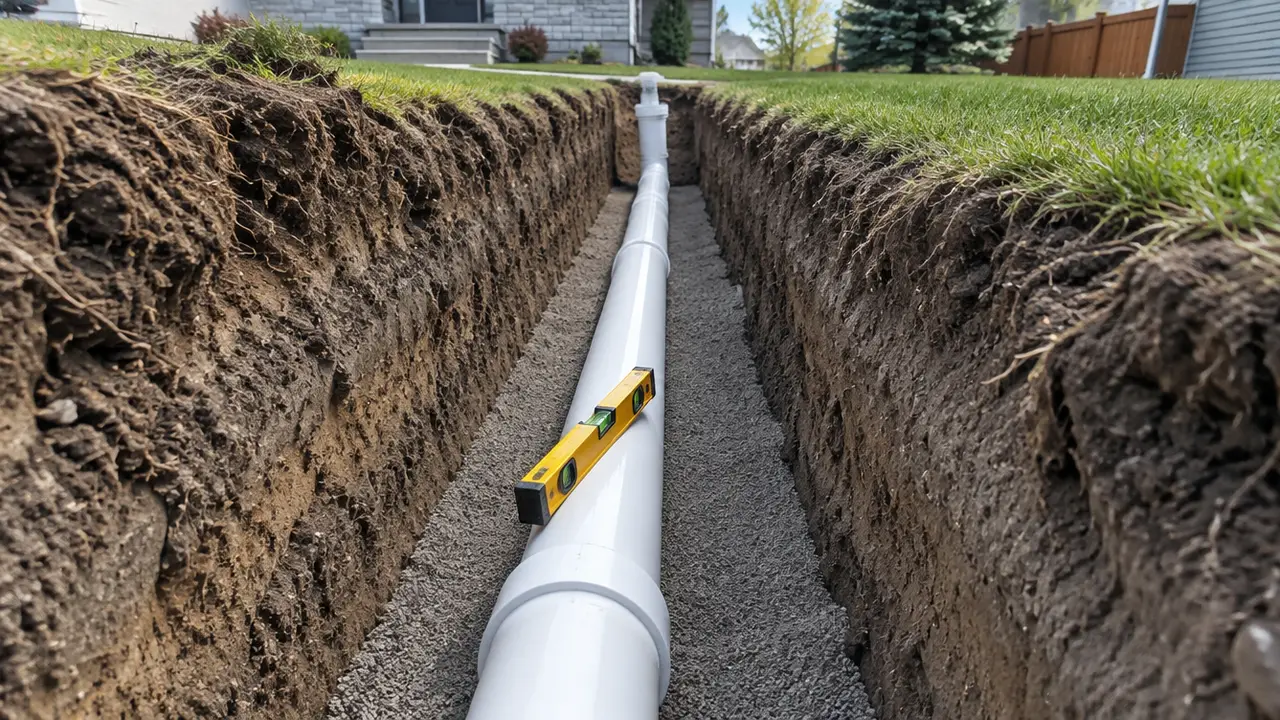
Often a surprising amount. Restoration covers whatever sits above the pipe: sod, landscaping, a driveway, a sidewalk, a basement floor. Backfill, compaction and restoration have a typical quoted range of $500–$15,000+, and the municipal connection or tie-in ranges from $0 to $15,000+ depending on whether any street, lane or boulevard work is needed.
Red Deer's page on installing sanitary, storm and water services shows what city-side work looks like in practice. Service replacement applications go to Engineering Services under Utility Bylaw 3606/2018, and the listed items include asphalt cutting and replacement, sidewalk and curb concrete, and turf repairs, with the fee per service provided by Engineering Services, as checked September 2026. Other cities handle it differently; the Alberta City Sewer Rules Finder shows each municipality's process.
07 /How much do permits and inspections add?
Permits and inspections have a typical quoted range of $150–$1,000+ inside a contractor's price. Published city fees give a floor, as checked September 2026: Edmonton lists a residential plumbing permit at $120 per address or unit plus a minimum $4.80 safety code fee (for work other than new single-family construction), Lethbridge's minimum plumbing permit fee is $110.00 plus the Safety Codes Council levy and rises with construction value, and Airdrie charges $100 for each homeowner-led trade permit from January 2026. Calgary publishes its fees in a schedule that rises every January 1.
08 /How do I compare per-metre and per-foot sewer prices?
Divide a per-metre price by 3.28 to get a per-foot price, because 1 m is about 3.28 ft. Alberta contractors often quote in metres, while many prices online are per foot and many of those are American. Converting the ranges on this site gives the comparison below.
| Method | Per metre | Per foot (approx.) |
|---|---|---|
| Open cut, soft landscaping, under 2 m | $600–$1,000 | $183–$305 |
| Open cut, 2.5–4 m deep or hard surfaces | $1,000–$2,000 | $305–$610 |
| Full-length CIPP lining (plus setup) | $500–$1,200 | $152–$366 |
| Pipe bursting (plus pits) | $550–$1,300 | $168–$396 |
A typical 15–25 m lateral is roughly 49–82 ft. Per-unit rates describe the pipe run only: the lining setup, bursting pits at $1,500–$6,000 each, the tie-in, permits and restoration sit on top of them.
09 /Why do online per-foot prices mislead Alberta homeowners?
Because they rarely describe the same job. A per-foot number found online may be in US dollars, may come from a region with shallow frost, and usually covers the pipe run while leaving out the pits, the city tie-in, restoration and permits. Short runs also carry fixed costs such as mobilisation and locates ($500–$2,000) over fewer metres, so a 12 m lateral always looks expensive per metre compared with a 40 m one.
Compare total prices for the same written scope instead, and check each quote against the stack of line items. Before pricing anything, make sure the evidence supports replacement: the Replacement Readiness Check shows the gaps to fill. When you have a scope, send it through the request form.
FAQQuestions people ask
Why did my Calgary sewer quote come in far higher than the per-foot price I saw online?
The online number probably covered pipe only, possibly in US dollars and for a shallow line. A Calgary quote usually includes depth-driven trench protection, the tie-in, permits, restoration and mobilisation. Convert the quote to a total per scope item and compare like with like.
Does winter frost add to the price of a sewer replacement in Edmonton?
Usually. Frozen ground has to be broken or thawed before digging, production is slower, and backfill must go back unfrozen. Where the failure is not an emergency, getting camera evidence and quotes in autumn gives more room to schedule.
Why does a deeper sewer in Alberta need a wider trench?
Past 1.5 m, the OHS Code requires cut-back walls or a protective structure. Cutting back at 45° in loose soil adds roughly the trench's depth in width on each side, so deeper lines mean much wider excavations or shoring equipment.
What does a Red Deer service replacement add for asphalt, curb and sidewalk work?
Red Deer's Engineering Services page lists asphalt cutting and replacement, sidewalk and curb concrete and turf repairs among the items in a service application. It does not publish amounts; ask Engineering Services (403-342-8158) for the fee per service.
How do I convert an Alberta per-metre sewer quote into dollars per foot?
Divide by 3.28. For example, $1,000 per metre is about $305 per foot and $2,000 per metre is about $610 per foot. Remember that setup, pits, the tie-in and restoration are usually priced separately from the per-metre run.
Is a trench box cheaper than cutting back the walls on an Alberta sewer dig?
It depends on the soil, the depth and the space available. Cutting back needs room and moves more soil; a trench box keeps the trench narrow but adds equipment and handling. Ask each contractor which protection they plan and why.
NETWORKGo deeper across the HAUSE Sewer network
Sewer line cost per foot (and per metre): how the rate really works
Sewer line cost per foot in Canada (2026): open-cut, lining and bursting rates per foot and metre in CAD, why short runs cost more, and how to check a quote.
SewerRoots.caSewer root removal cost in Canada: cutting, chemicals and permanent fixes
Sewer root removal cost in Canada for 2026: planning ranges for cable cutting, jetting, camera, lining, bursting and replacement, plus cycle-versus-fix math.
PipeCleaning.caPipe cleaning cost in Canada, method by method
Pipe cleaning cost in Canada for 2026: planning ranges for snaking, hydro jetting, descaling, camera inspection and stacks, and what moves a quote.