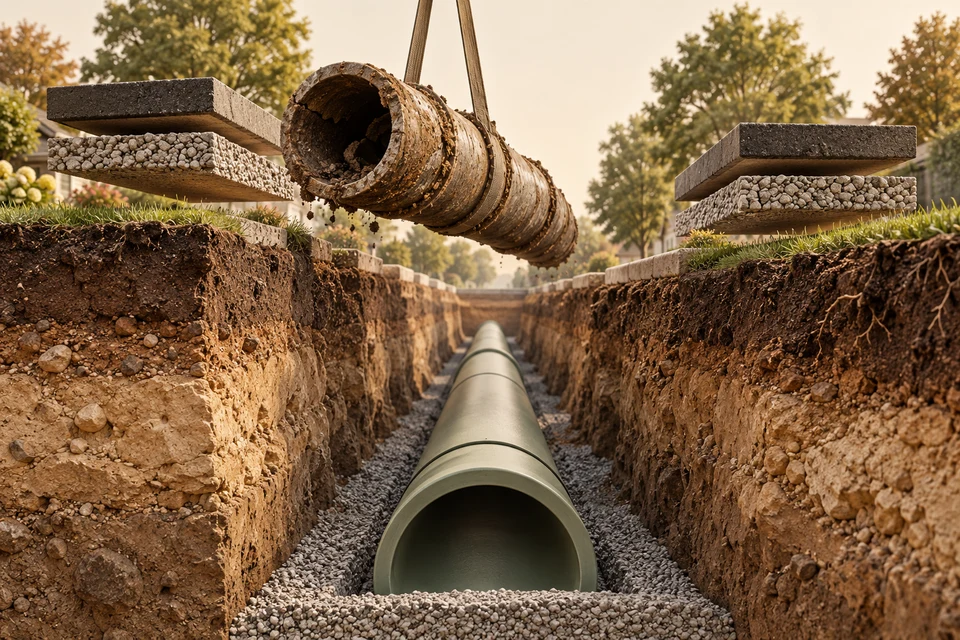
Open-cut sewer line replacement means excavating a trench along the lateral, removing the old pipe and laying new pipe on prepared bedding at a continuous grade. In Alberta it is the usual answer for a collapse, a sag, severe offsets or pipe too deformed to line. It disturbs the surface along the dug length, so the written scope must define excavation limits and restoration.
- Open cut is the one method that corrects grade, because the trench bottom itself is rebuilt under the new pipe.
- Alberta's OHS Code requires wall protection for workers in trenches deeper than 1.5 m, which is why deep laterals cost more to dig.
- Private sewer and water service lines are not marked by Click Before You Dig; a private locator has to find them.
- Restoration is the line item most often left vague; ask which surfaces are put back and to what standard.
- Every city on this site has its own permit or approval body; the quote should name who applies and who books inspections.
01 /When is open-cut sewer line replacement the right call?
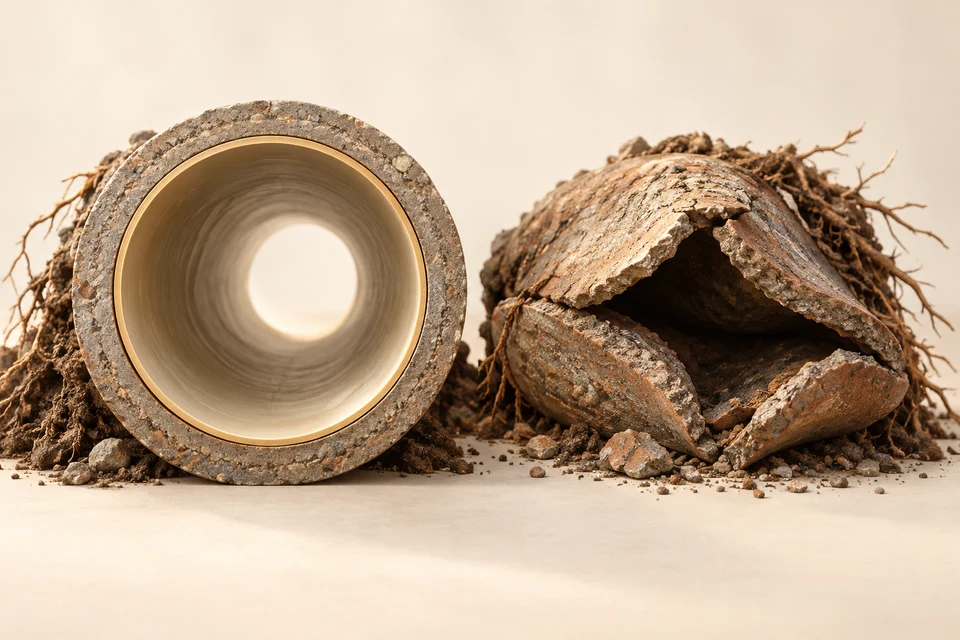
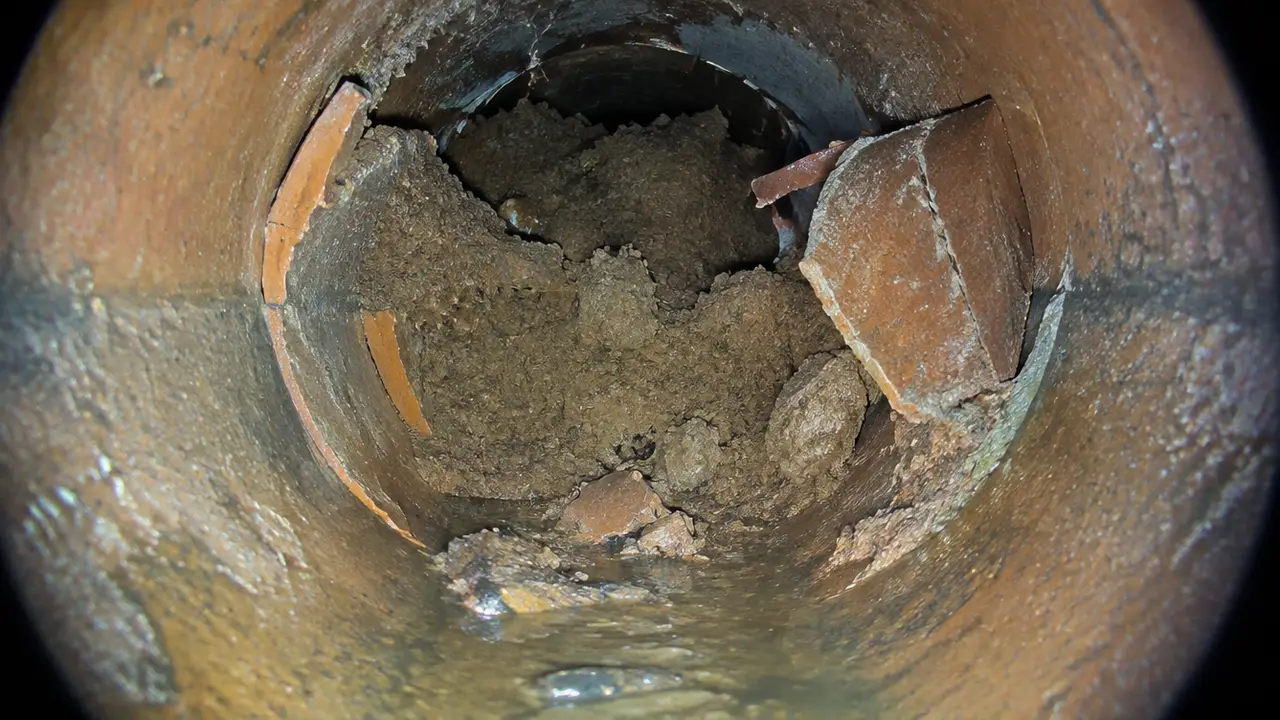
Open cut is justified when the camera shows a condition no trenchless method can correct: a collapsed or missing section, a belly that holds water, joints offset far enough to catch a camera, or pipe so deformed that a liner has nothing round to cure against. EPCOR's sewer line guidance for Edmonton (as checked September 2026) is blunt about two of these: sags can only be fixed by removing the affected pipe and regrading the trench bottom, and replacing a collapsed portion is the only viable option.
It is also the practical choice when the pipe has to change: a new route around a garage addition, a new depth to get below frost, a larger diameter, or a lateral so short and shallow that digging costs less than setting up lining equipment. It is not automatically better than trenchless work. Direct access solves some conditions; lining and bursting solve others. The methods hub shows which findings point where.
02 /What should an open-cut replacement scope cover?
A sound open-cut scope answers six questions in writing before anyone digs. They are the same six review points this page has always used, expanded with what to look for on an Alberta job.
| Review item | What it means | What to see in writing |
|---|---|---|
| Direct pipe access | The trench exposes the run so alignment, bedding and connections can be rebuilt | The start and end points, measured from the foundation and property line |
| Broad condition range | Open cut handles collapse, deformation, poor grade and defects a liner cannot reach | Which camera findings justify digging instead of lining |
| Defined restoration scope | Soil, landscaping, concrete and paving disturbed by the dig | Each surface listed, with what is restored and what is excluded |
| Utility coordination | Locates, safe excavation and shoring | Who requests locates, who hires the private locator, and how walls are protected |
| Permit review | Permits and inspections vary by municipality and connection location | The permit holder, the inspections, and who pays the fees |
| Post-work evidence | Proof of the installed line, grade and connections | A post-work camera run and any test the permit or contract requires |
03 /What do Alberta's trench safety rules require?
Alberta's Occupational Health and Safety Code, Part 32, sets the trench rules every employer on a sewer dig must follow. As checked September 2026, four sections matter most for a residential lateral:
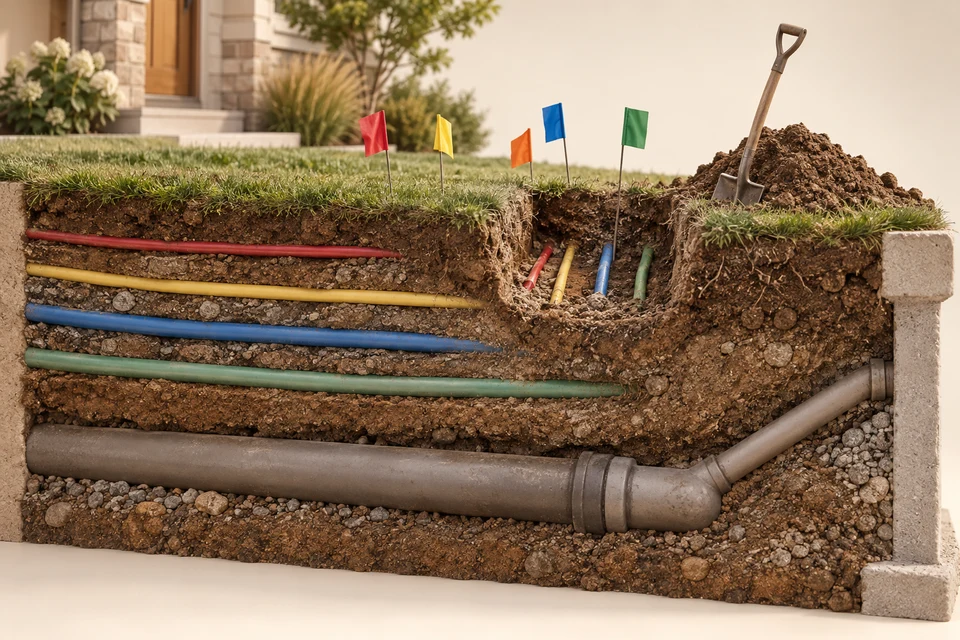
- Section 447: before ground is disturbed, the employer must contact the owners of buried facilities, have them marked, and not dig until they are marked.
- Section 450: a worker in an excavation more than 1.5 m deep, and closer to the wall than the depth of the excavation, must be protected by cutting back the walls, by a temporary protective structure such as a trench box or shoring, or both. Solid rock is the exception.
- Section 451: cut-back walls must slope at not less than 30° from vertical in hard, compact soil and 45° in soil likely to crack or crumble, to within 1.5 m of the bottom; in soft, sandy or loose soil the slope starts from the bottom at 45°.
- Section 453: spoil piles must sit at least 1 m back from the edge of the excavation, with a slope of not more than 45°.
Those rules explain much of what a deep lateral costs. Sloping the walls back widens the trench at the surface and multiplies the soil moved; a trench box avoids that but has to be brought in and moved along. Utility Safety Partners' Click Before You Dig service needs at least three full working days' notice and does not mark customer-owned lines such as the sewer and water service, so a private locator is part of the job. The locates and digging safely guide covers the full process.
04 /How do bedding, backfill and grade decide how long the new line lasts?
A new pipe fails early when it is not evenly supported or not laid at a steady fall. Open cut is the only method where the contractor controls both, which is also why it is the only method that permanently fixes a sag.
- Trench bottom. Soft spots, organic soil and rocks are removed so the pipe will not settle unevenly. A belly in the old line often traces back to a soft bottom that was never corrected.
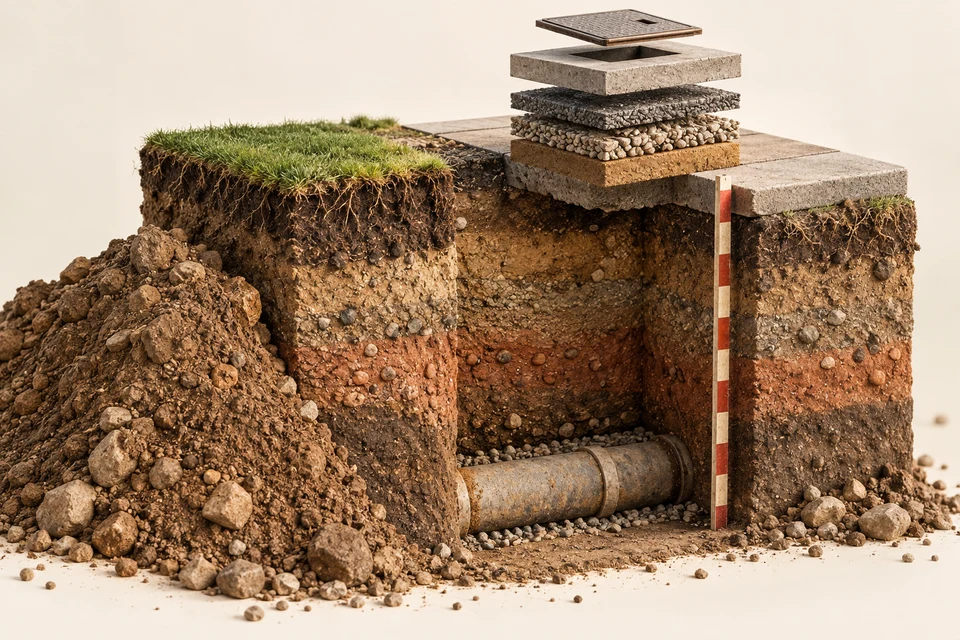
- Bedding. Granular material is placed and shaped under and around the pipe so it bears along its full length, not on its bells or on stones.
- Grade. The pipe needs a continuous fall toward the main with no reverse slope, at no less than the minimum the National Plumbing Code sets for its size. A laser or level check before backfill is worth asking about.
- Backfill and compaction. Fill goes back in layers and is compacted, keeping large stones away from the pipe. Poor compaction shows up later as a sunken lawn or cracked walkway.
- Frost. Alberta laterals are buried deep to stay below frost. Confirm the design depth and any insulation with the permit body and contractor rather than a rule of thumb.
Installation craft in depth is the lane of SewerInstall.com. For a replacement decision, the point is simpler: ask how the bottom, bedding, grade and compaction will be checked, and whether the inspector sees the pipe before it is covered.
05 /How should restoration be scoped?
Restoration should be priced surface by surface, because it is where open-cut quotes differ most and where disputes start. A proposal that says only 'backfill and restore' leaves every decision until the hole is open.
- Lawn and soil: rough grade only, topsoil and seed, or sod; and who deals with settlement over the following season.
- Trees and shrubs: which are removed, which are protected, and whether roots will be cut near the trench.
- Concrete: sidewalk panels, steps and driveway slabs are usually cut and replaced by the panel; ask whether the new pieces match.
- Asphalt and curbs: often a separate trade, and on the public side sometimes a municipal requirement.
- Fences, decks and sheds: removal, storage and reinstallation, or exclusion.
Red Deer's service application list, for example, names asphalt cutting and replacement, sidewalk and curb concrete, and turf repairs as items within the City's process (as checked September 2026). Other cities handle public-side restoration differently; confirm it with the permit body before comparing quotes.
06 /Which permits apply to open-cut replacement in each city?
Every city on this site requires a permit or approval to replace a sewer service; what differs is the body, the applicant and the inspection. As checked September 2026:
| Municipality | Permit or approval | Who applies |
|---|---|---|
| Calgary | Plumbing permit when sewer lines in or around the home are replaced; rough-in and final inspections | An owner-occupier doing the work, otherwise the contractor |
| Edmonton | Residential plumbing permit, $120 per address or unit plus a minimum $4.80 safety code fee (other than new single-family construction) | An owner-occupier of a single detached house, otherwise a City-licensed contractor |
| Red Deer | Engineering Services approval under Utility Bylaw 3606/2018; final signature and payment in person at City Hall | Anyone removing or installing the service |
| Airdrie | Accessory permit for plumbing; $100 per homeowner-led trade permit from January 2026 | Homeowner-led or contractor-led (hired contractors are exempt from the $100 fee); confirm with Building Inspections |
| Okotoks | Written approval of the CAO under Bylaw 25-21; work at the applicant's cost | The applicant, in writing |
| Lethbridge | Plumbing permit to replace sewer connections; minimum fee $110.00 plus the Safety Codes Council levy | A licensed plumbing contractor, or a competent resident homeowner |
Alberta has used the National Plumbing Code of Canada 2020 since April 1, 2023, and the province notes that contractors may need a Restricted Certificate of Competency 'R' for sewer and water services. The City Sewer Rules Finder adds each city's ownership split and source link, and the DIY permit guide covers homeowner permits.
07 /What does a typical open-cut project look like, step by step?
- Review the camera record
Confirm the failure type, location, extent and pipe material, and whether the full run was viewed.
- Map scope and access
Locate the private lateral, the property boundary, public utilities, connection points, depth and surface constraints.
- Confirm the proposal
Check excavation limits, pipe material and diameter, grade, bedding, permits, inspections, exclusions, restoration and written terms.
- Excavate and replace
The chosen contractor exposes the agreed section, protects the walls as Part 32 requires, and installs the specified pipe and connections.
- Test and document
The inspector sees the work before cover where the permit requires it, and a camera run records the new line.
- Restore agreed surfaces
Backfill, compaction and restoration follow the written scope, not assumptions made before the dig.
08 /What does open-cut sewer replacement cost in Alberta?
For a 15 to 25 m residential run, open-cut replacement is typically quoted at $12,000–$35,000+. Soft landscaping under about 2 m deep runs around $12,000–$25,000 ($600–$1,000 per metre); deep trenches of 2.5–4 m or runs under hard surfaces reach $22,000–$50,000+ ($1,000–$2,000 per metre).
- Mobilisation and utility locates: $500–$2,000.
- Permits and inspections: $150–$1,000+.
- Municipal connection or tie-in: $0 to $15,000+, depending on who owns the public side and what the city requires.
- Backfill, compaction and restoration: $500–$15,000+.
- Post-work camera video: $0–$400.
- Adding a backwater valve while the line is open: $1,800–$4,500.
The pricing page shows how the line items stack, and why Alberta costs more explains depth, frost and trench rules. With the line open, it is also the cheapest moment to add a backwater valve.
09 /What should you ask an open-cut contractor?
- Show me the camera evidence and the measured defect locations.
- Why is a spot repair or trenchless option unsuitable for this line?
- Which permits, locates, excavation limits and restoration items are included?
- What pipe material, diameter, grade, bedding and connections will you install?
- How will you protect the trench walls if it is deeper than 1.5 m?
- Do you hold a prepaid contracting licence if you take a deposit? (Service Alberta's Find a Licensed Business search confirms it.)
- What testing, inspection, warranty and exclusions will be in writing?
Bring the answers and the camera record to the request form for a scope review, or run the Replacement Readiness Check first.
FAQQuestions people ask
When do Alberta contractors recommend open-cut sewer replacement over a liner?
Usually when the camera shows a collapse, a belly holding water, badly offset joints or deformed pipe. EPCOR states that a sag can only be fixed by removing the pipe and regrading, which only excavation does. The contractor should tie the recommendation to measured findings.
Does open-cut replacement in Alberta mean digging up the whole yard?
Not always. The trench follows the affected run, and its width depends on depth and soil because walls over 1.5 m need cutting back or shoring. Ask for the excavation limits and the restoration of each surface in writing.
Is open-cut replacement better than trenchless for older Calgary and Edmonton laterals?
Neither is better in general. Open cut gives direct access and fixes grade; lining keeps the surface intact when the host pipe is sound; bursting replaces broken pipe along the old route. The camera record should justify the choice.
Who books the sewer inspections on an open-cut job in Alberta cities?
The permit holder. In Calgary and Edmonton that is the owner-occupier doing the work or, far more often, the contractor. The written proposal should name the permit holder, the inspections, the fees and who pays each.
What warranty should an Alberta open-cut sewer replacement come with?
Terms vary by contractor, pipe material and scope. Ask for the labour warranty and the manufacturer terms in writing, including exclusions, transfer to a buyer and the claim process, before you sign or pay a deposit.
Can open-cut sewer work in Alberta go ahead in winter?
It can, but frozen ground, frost protection and restoration timing change the price and schedule. Landscaping restoration is often deferred to spring. Confirm how the contractor handles frozen spoil, heating and deferred restoration in the written scope.
NETWORKGo deeper across the HAUSE Sewer network
Sewer line replacement cost: open-cut vs trenchless, line by line
Sewer line replacement cost in Canada for 2026: open-cut, CIPP lining and pipe bursting planning ranges in CAD, per-metre math, line items and what moves price.
SewerInspector.caShould you scope the sewer before buying a house?
When a sewer scope before buying a house is worth it, which homes need one most, how to fit it inside a condition period, and what to do with the result.
SewerRoots.caSewer lining for tree roots: will a CIPP liner stop them for good?
Sewer lining for tree roots: how a CIPP liner seals root-damaged joints, which lines qualify, preparation, weak points at the ends, and planning costs.