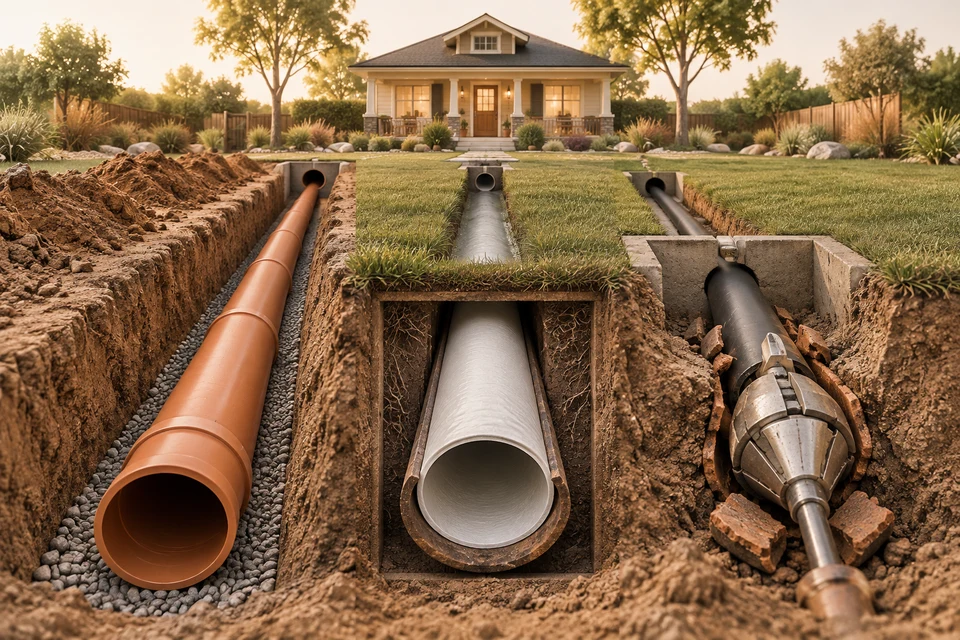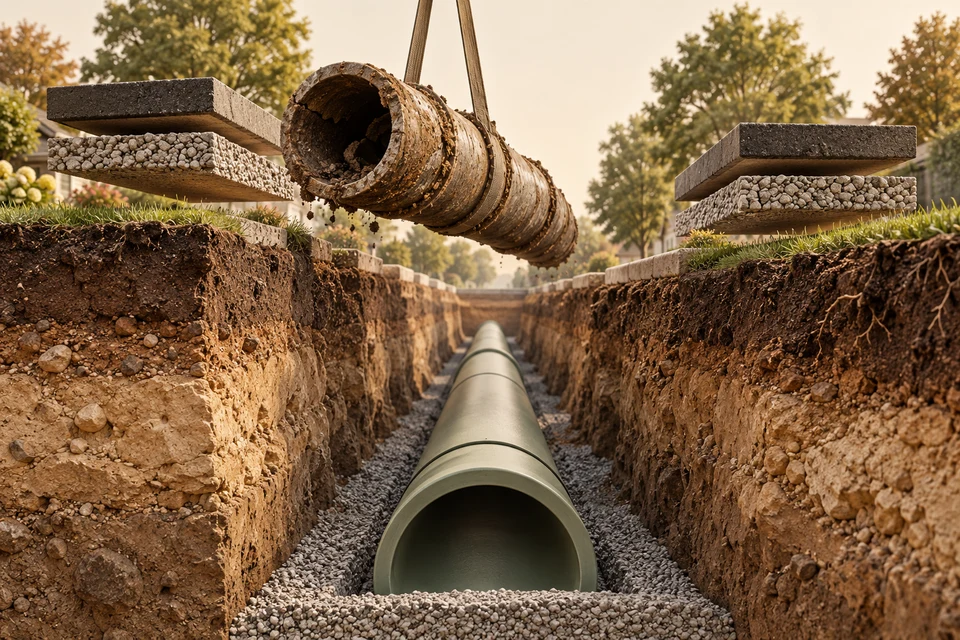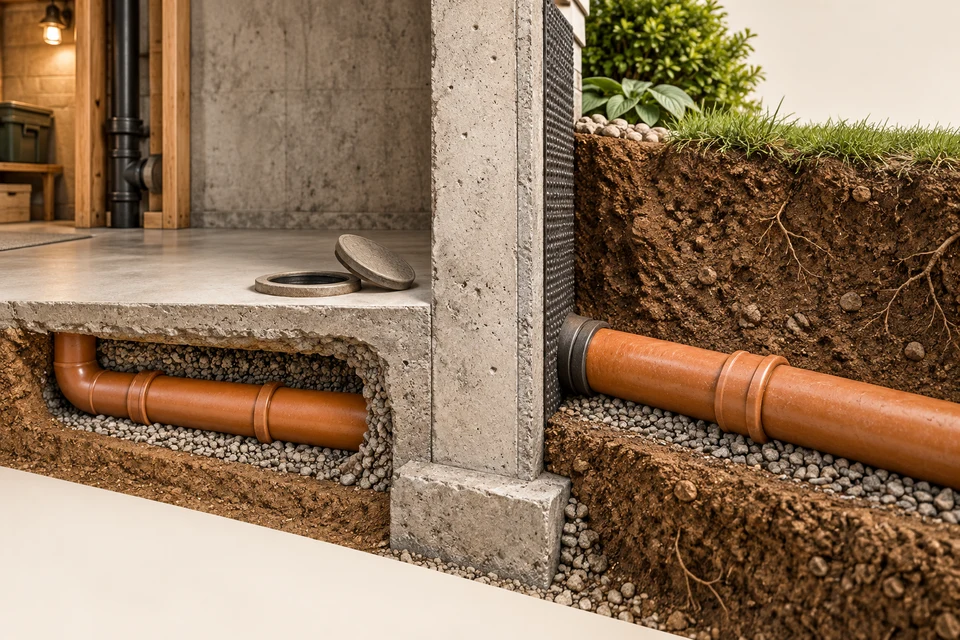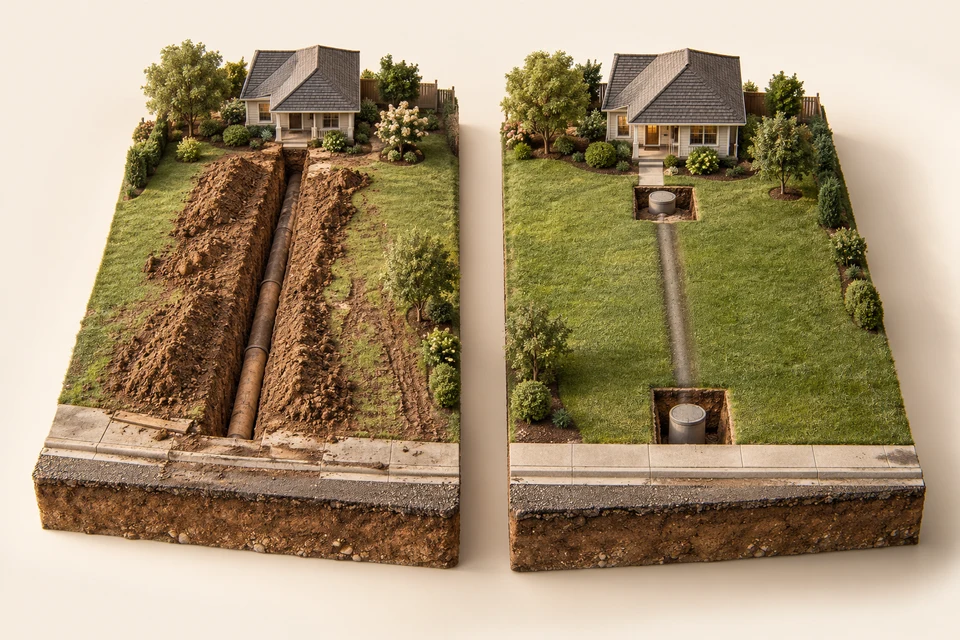
Trenchless sewer repair can disturb far less ground than a trench, which protects tree roots, topsoil and hard surfaces and cuts the soil that must be dug, stored and hauled. The benefit is not automatic or a fixed percentage: it depends on the number and size of access pits, the resin and cure process, waste handling and how long the result lasts. Compare the actual scopes.
- There is no universal percentage reduction; the environmental case for trenchless rests on the specific access plan, materials and waste handling in each scope.
- Simple trench geometry shows why excavation volume matters: depth and Alberta's trench-protection rules can multiply the soil that is dug and stored.
- Pits placed clear of a mature tree's root zone can save a tree that a trench along the same route would cut through.
- Lining brings its own handling questions, from resin type and odour to where the cure water goes.
- Open cut can be the lower-impact choice when the pipe needs regrading, the run is short and shallow, or the yard is being dug anyway.
01 /Why compare the actual scope, not the method label?
Because the environmental effect of a sewer job comes from what is dug, moved, brought in, thrown away and repeated, and those quantities differ more between scopes than between method names. A lining job that needs three pits because of branch connections can disturb nearly as much as a short trench under lawn. A bursting job with two tidy pits can spare a driveway, a tree and several truckloads of soil.
Ask every contractor to state the excavation limits, the equipment, the material hauled away and brought in, the waste and how it is handled, the restoration, and the product documentation. This page does not assign a universal percentage reduction, and you should be wary of any quote that does.
02 /How much soil does a sewer trench actually move?
A trench moves soil in proportion to its width, its depth and its length, and Alberta's OHS rules can widen the top of a deep trench considerably. The figures below are illustrative geometry, worked from simple shapes; they are not measurements from any job, and they show in-ground volume before the soil loosens and bulks up on excavation.
As checked September 2026, Alberta's OHS Code Part 32 requires a worker in an excavation deeper than 1.5 m, and closer to the wall than the depth, to be protected by cutting back the walls, a temporary protective structure such as a trench box, or both. Cut-back walls are sloped at not less than 30 degrees from vertical for hard and compact soil and 45 degrees for soil likely to crack or crumble, to within 1.5 m of the bottom, and from the bottom at 45 degrees for soft, sandy or loose soil. Spoil piles must sit at least 1 m back from the edge with slopes no steeper than 45 degrees.
| Excavation shape | Cross-section per metre | Volume per metre | 20 m run |
|---|---|---|---|
| Vertical walls with a protective structure | 0.75 m wide x 2.4 m deep | 1.8 cubic metres | 36 cubic metres |
| Crumbly soil: bottom 1.5 m vertical, upper 0.9 m cut back at 45 degrees | 0.75 m base widening to 2.55 m at the top | About 2.6 cubic metres | About 52 cubic metres |
| Soft soil: cut back at 45 degrees from the bottom | 0.75 m base widening to 5.55 m at the top | About 7.6 cubic metres | About 151 cubic metres |
| Two access pits, 1.2 m x 2.0 m x 2.4 m each | Pits only | Not applicable | About 11.5 cubic metres |
The spoil has to go somewhere while the pipe is laid. Stored as a windrow beside the trench with 45-degree sides, 36 cubic metres over 20 m needs a pile about 1.3 m high and 2.7 m wide at the base, plus the 1 m setback, so a strip nearly 4 m wide along the whole trench before any bulking. On a city lot that strip is usually lawn, garden or a neighbour's side yard.
Real jobs vary: shoring changes the widths, some soil is reused as backfill and some is replaced with imported granular material, and pits for bursting or lining need protection too once they pass 1.5 m. The point of the arithmetic is the ratio. On a deep run, a pit plan can move a fraction of the soil a trench would, and that fraction is worth asking each contractor to state.
03 /What happens to trees, topsoil and landscaping?
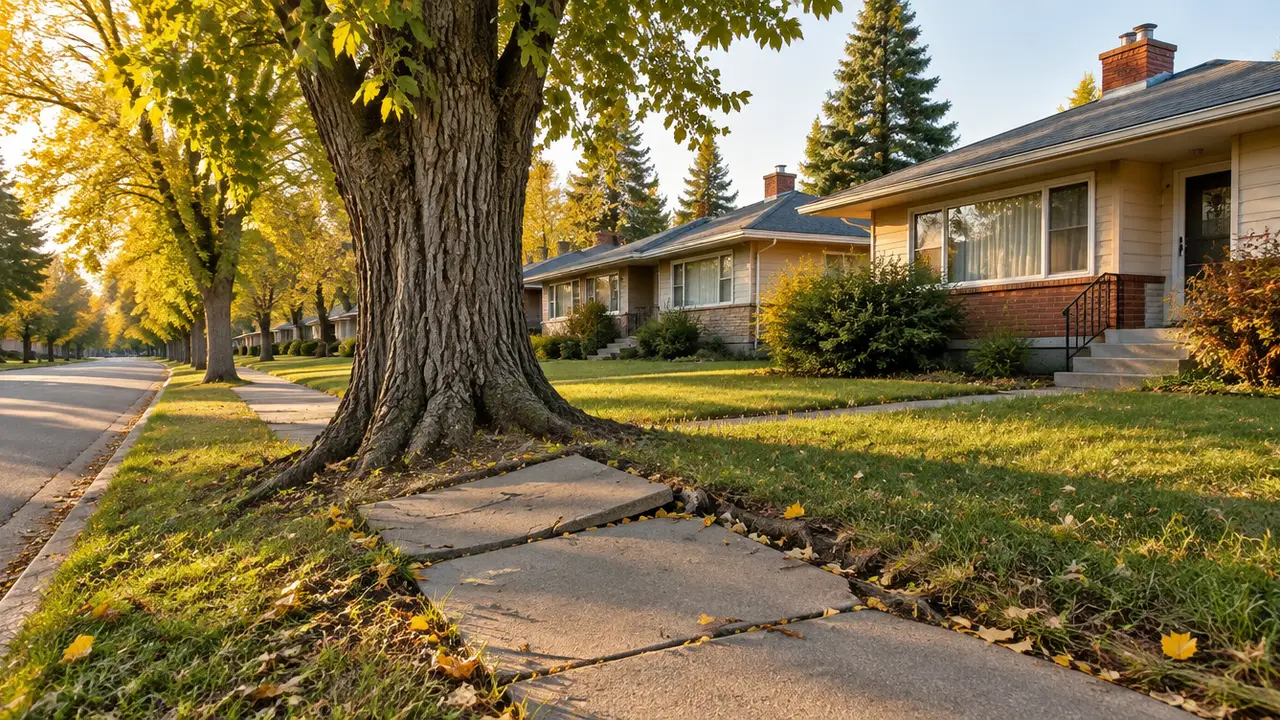
Trees are where the difference between a trench and a pit plan is easiest to see. Much of a tree's feeding root system spreads through the upper soil, well beyond the trunk. A trench running under the canopy cuts every root that crosses it, and a tree can decline for years afterwards. Pits placed outside the root zone, with the new pipe drawn or lined underneath, can leave those roots alone.
- Ask for the pit locations on a sketch, measured from the trunk of any mature tree near the line.
- Involve an arborist before any dig inside the canopy of a tree you want to keep.
- Topsoil stripped for a trench is mixed and compacted in handling; a trenchless plan disturbs topsoil only at the pits.
- Interlocking pavers, patios and irrigation lines can often be lifted and relaid, but concrete and asphalt are broken and replaced.
In older Calgary and Edmonton neighbourhoods, boulevard trees and mature backyard spruce often sit near the sewer route, which is a common reason homeowners look at trenchless lining in the first place.
04 /How do machinery, hauling and waste compare?
Every cubic metre dug out and every cubic metre of granular fill brought in is a truck movement, and broken concrete, asphalt and old pipe add disposal loads. The geometry above gives you the scale: a job that digs 50 cubic metres and imports bedding and backfill needs far more trips than one that digs two pits.
Trenchless work is not waste-free. Descaling and cleaning before a liner produce debris that must be captured, and bursting leaves fragments of the old pipe in the ground around the new one. Ask where each waste stream goes.
05 /What should you ask about resin and cure water?
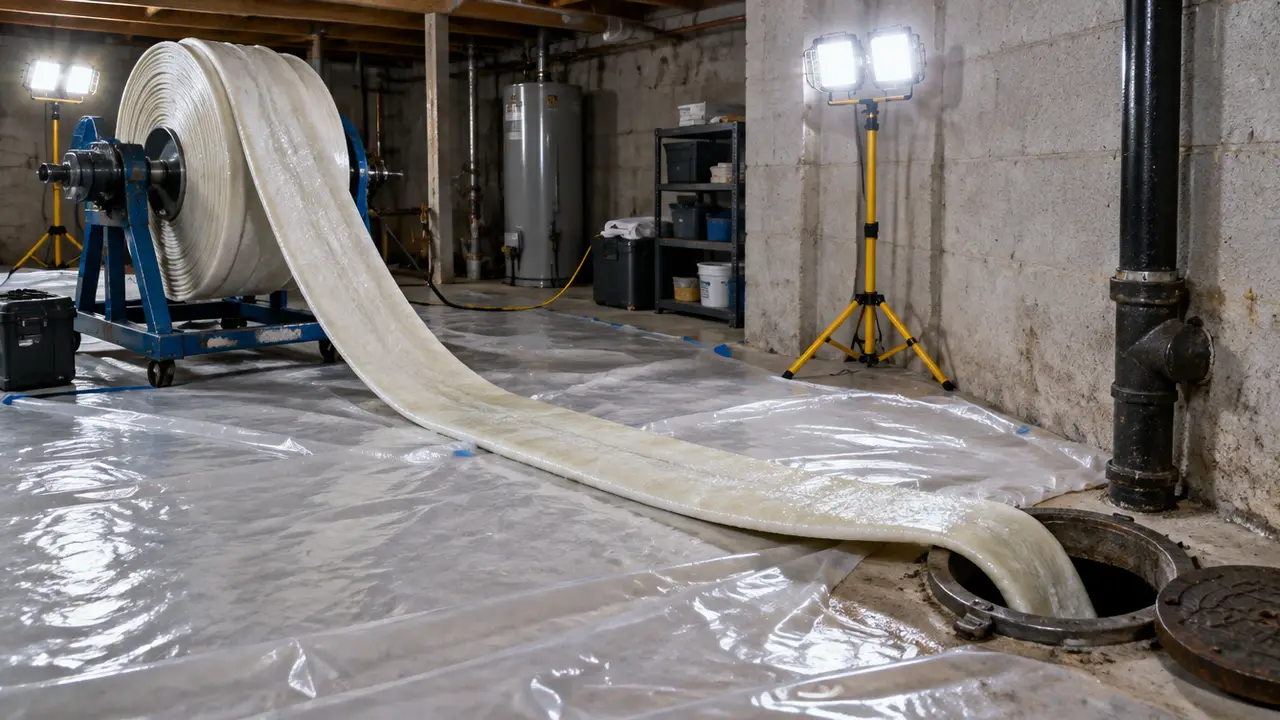
Cured-in-place lining uses a resin that hardens inside the old pipe, and its handling deserves the same questions as any other chemical product on your property. Resin chemistry differs between systems; some give off a strong odour during installation and cure.
- Which resin system is used, and can I see the product documentation?
- Is the liner wetted out off site or on my driveway, and how is excess resin captured?
- How is the liner cured: hot water, steam, UV light or ambient? Where does any cure water or condensate go, and is it captured rather than released to the storm system?
- How will odour be kept out of the house during the cure, for example by keeping traps full and ventilating?
- When can we use the drains again?
06 /Groundwater, soil and the long term
A trench opens a long strip of soil to rain and meltwater, and a wet Alberta spring can turn it into a channel for silt. Smaller pits reduce that exposure, though they still need dewatering controls if groundwater is high. Leaving undisturbed soil around the pipe also avoids a strip of loosened backfill that settles over the following seasons.
The long-term side is where environmental claims get stretched. Fewer joints can mean fewer places for roots and infiltration, but connections, liner ends and transitions to old pipe remain. The best long-term outcome is a repair that fixes the worst defect properly, so nobody digs the same yard again in a few years.
07 /When is open cut the lower-impact choice?
- The pipe needs regrading. EPCOR states that sags can only be fixed by removing the affected pipe and regrading the trench bottom; lining leaves the belly in place, and a repair that fails early means a second job and a second disturbance.
- The run is short and shallow under lawn with no trees or hard surfaces over it; a narrow trench may move little more soil than two pits.
- Many connections would each need a pit, so the trenchless plan ends up with nearly as much excavation.
- Other digging is already planned, such as regrading the lot, renewing the water service or foundation repairs.
- The line needs relocating away from a foundation or a new addition.
The traditional vs trenchless comparison sets out which defects point to which method.
08 /A checklist for comparing environmental scope
- Every excavation, with dimensions and location, including pits at connections.
- Material dug out, reused, hauled away and brought in.
- Trees near the route and how their roots are protected.
- Cleaning waste, resin handling, cure water and old pipe disposal.
- Restoration of every disturbed surface.
- Product documentation and expected maintenance.
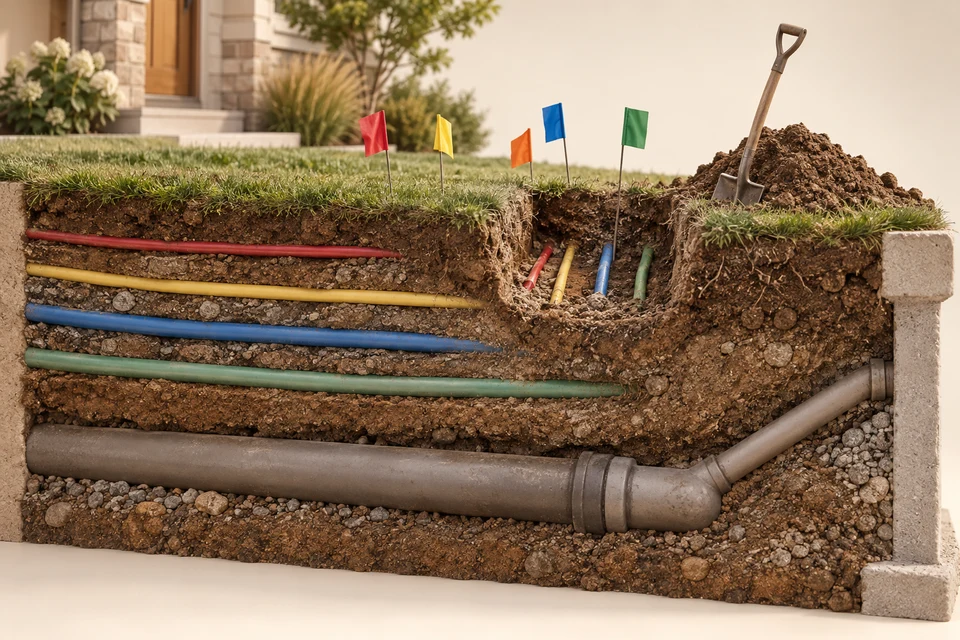
- Permits and any municipal requirements for the city side, plus locates: Utility Safety Partners asks for requests at least three full working days ahead, and private sewer and water service lines are not marked.
Decide method eligibility first with the Replacement Readiness Check, then compare the scopes on this list. Send both proposals through the request form for a side-by-side review.
FAQQuestions people ask
Do Alberta trench-safety rules make a deep sewer trench wider at the surface?
They can. The OHS Code requires protection for workers in excavations deeper than 1.5 m, by cutting back the walls, a protective structure, or both. Cut-back walls widen the trench at the top, which increases the soil moved and the area restored.
Can trenchless sewer work save a mature spruce near an Edmonton sewer line?
Often, if the access pits can be placed outside the root zone and the pipe is a candidate for lining or bursting. Get the pit locations on a sketch and ask an arborist before any dig inside the canopy.
Where does CIPP cure water go on a Calgary lining job?
Ask the contractor before work starts. Cure water or condensate should be captured and handled as the product and local rules require, not released to a storm drain. UV-cured systems do not use cure water.
Is pipe bursting better for the environment than lining in Alberta clay?
Not as a rule. Bursting leaves old pipe fragments in the ground and needs pits at each end and at connections; lining keeps the old pipe and uses resin. Compare the excavation, waste and materials in each written scope.
Why would an Alberta homeowner choose open cut for environmental reasons?
When the pipe needs regrading, the run is short and shallow under lawn, many connections would each need a pit, or the yard is being dug anyway. A repair that lasts avoids a second disturbance.
NETWORKGo deeper across the HAUSE Sewer network
Sewer line replacement cost: open-cut vs trenchless, line by line
Sewer line replacement cost in Canada for 2026: open-cut, CIPP lining and pipe bursting planning ranges in CAD, per-metre math, line items and what moves price.
SewerRoots.caSewer-safe trees and shrubs to plant near a sewer line
Sewer-safe trees and shrubs for Canadian yards: small, slow, prairie-hardy species to plant near sewer lines, what to put over the trench, and what to avoid.
SewerInspector.caSewer scope inspections in Edmonton: what to expect and who to call
Sewer scope and sewer line inspection in Edmonton: what mature and newer neighbourhoods show on camera, cold and clay soils, elms, EPCOR and 311 checks.